Description
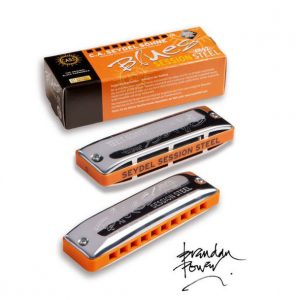
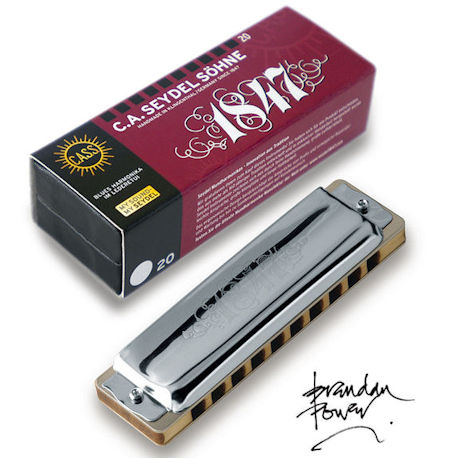
Seydel 1847 Classic Power Draw harmonica in key A.
With the Power Draw Tuning, holes 1-6 are the same as a diatonic harmonica, and it lets you really wail in the higher notes.
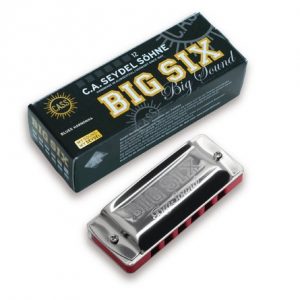
If you are familiar with playing in holes 1-6 on richter diatonic already (or you play Seydel’s Big Six harmonica), the Power Draw is a good choice for you. Think of it as the Big Six Plus!
The Seydel 1847 Classic Power Draw is a harmonica that combines tradition and innovation. With its super airtight design and Seydel’s unique Stainless Steel reeds, this harmonica really shows its expressive potential throughout the range in Power Draw tuning.
Power Draw tuning is easy to learn because:
The bulk of the harmonica (holes 1-6) stays exactly the same, so there is no need to re-learn anything in that range you’re accustomed to.
The breathing pattern of holes 1-6 (blow reed low, draw reed high in each hole)is retained all the way up to hole 10 on the Power Draw. This gives the top octave an instant feeling of familiarity to anyone who tries it, because the techniques and riffs that work so well lower down work up there too.
Simplified Technique: There are no blow bends and no overdraws needed in the Power Draw tuning. Two of the most important ‘blue’ notes in 2nd position (the flat third, which was overblow 6) and the flat fifth (overdraw 7) are now simple draw bends on holes 7 and 8.
Every draw note bends from hole 6-10, soulful and easy! In un-valved setup every hole overblows, and the upper octave overblows are much easier than the overdraws necessary in Richter tuning.
Power Draw works well with the chordal octave-playing approach of tongue blockers. The notes in the top octave are similar to Richter, but the intervals are different. Because the chord splits sound nice and in-key, it is easy to adapt to.
The Power Draw works great in other positions too, especially Third (nice useful bends in the top octave), Fifth (good expression in the top end), Second Position Minor (no need to overblow to get the flat 3rd ), Eleventh and Twelfth (great expression in the top octave).